Chapter 1 of 4
Finding Our Bearings
Two ways to give directions
There are two ways to describe a direction: relative to the body (right and left, forward and back), or relative to the world (north and south, east and west). In daily life we switch between them. We don’t tell a lost driver “turn south,” but “the second right.” But right and left are confusing when it isn’t clear which way the speaker is facing. When Abraham told Lot, “if you go left, I will go right,” had they been facing each other, one man’s right would have been the other’s left.
Right is south
But Abraham may not have meant our right and left. In biblical times, right and left also served as names for the compass points, on the assumption that a person stands facing east. “Kedem,” the front, is east; right is south; and left is north. This is how Onkelos translates: “If you go north, I will go south.” So too “Hobah, which is to the left of Damascus” lies north of Damascus, and “the hinder sea” is the Mediterranean, in the west.
Why face east? Perhaps because of the rising sun. As Nachmanides writes (Exodus 26:18), the language names the directions “after a person facing the light of the sun.”
East on top
On ancient maps, too, east was at the top. On the Madaba Map, an ancient mosaic map found in Jordan, the Dead Sea is drawn above Jerusalem. Hence the word “orientation”: whoever held a map had to “orient” himself, that is, turn toward the Orient.
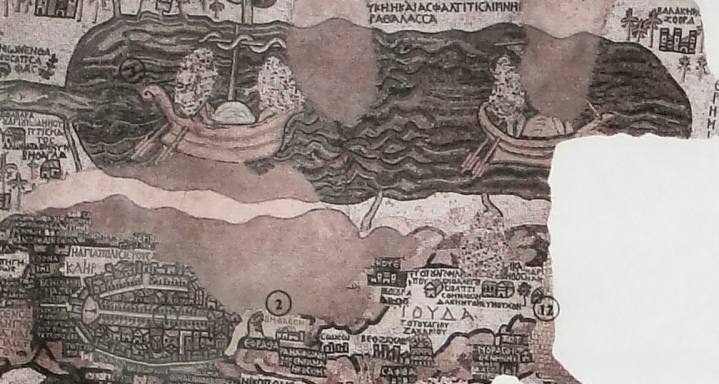
At the end of the Middle Ages this changed. The sun rises further north or south depending on the season, while the North Star is far more precise. When ships began sailing long distances, north moved to the top of the map. Today north and south are “up and down”: in Hebrew, one “goes up” to the Golan and “goes down” to the Negev.
Southward with Jabotinsky
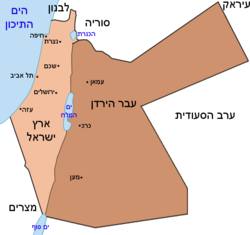
An amusing exception: Jabotinsky’s poem “The Left Bank of the Jordan.” The British Mandate originally included today’s Jordan as well, but Churchill divided it and gave Transjordan to Abdullah. Jabotinsky saw this as theft, and wrote: “Let my treacherous right hand forget, if I forget the left bank of the Jordan.”
Why is Transjordan on the “left”? Because Jabotinsky wrote the poem in Paris. The city is divided into the Left Bank and the Right Bank of the Seine, according to the direction of the river’s flow. So he too stood facing the flow of the Jordan, southward, and Transjordan came out on the left.
Between time and space
“Reuven runs before Shimon” means that Shimon is facing Reuven. But “ten before noon” means that noon faces the past and has its back to the future. Why? We feel the future is in our hands, so we face it. In the past, the future was seen as unknown, “behind our back,” and people faced the past, which they could “see.” So in tractate Chagigah (16a): the Mishnah forbids inquiring into “what is in front and what is behind,” and the Gemara asks: “In front – what has been has been?” In other words, “in front” is the past.
Why do clocks go “clockwise”?
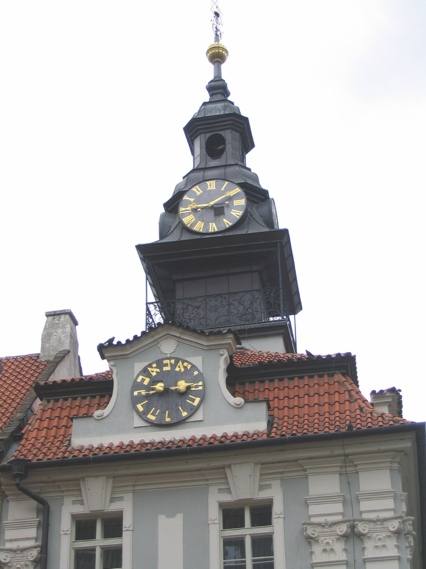
Because of the sundial. Its shadow falls to the west in the morning, to the north at noon and to the east in the evening, and mechanical clocks copied this motion. An exception: at the Altneuschul synagogue in Prague, the Hebrew clock runs backward. Whoever built it assumed that if Jews write from right to left, their clock should run backward too.
“All the turns you make should only be to the right”
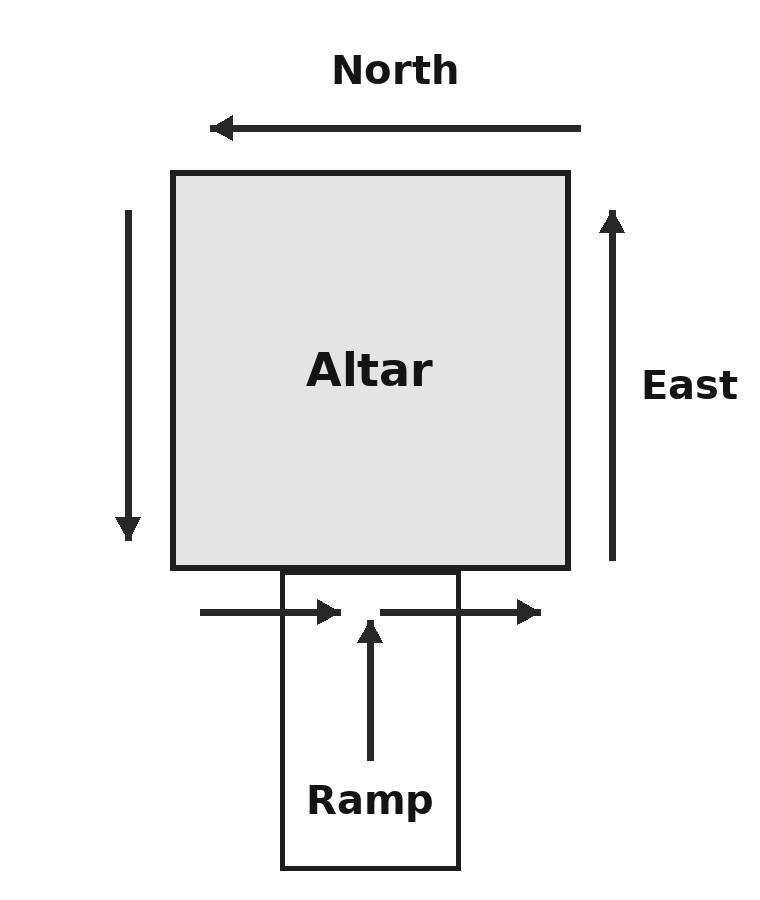
The Kohanim went up to the altar by the kevesh, the ramp leading up to it, facing north. According to the law (Maimonides, Laws of Sacrificial Procedure 7:11), “they go up by the right and walk around.” But this is puzzling: after one turn to the right, it takes three turns to the left to go around the altar!
The Gemara (Zevachim 62b) brings proof from Solomon’s “sea,” a great basin resting on twelve sculpted oxen: “three facing north, three facing west, three facing south and three facing east.” But for someone facing north, the order north–west–south–east actually goes to the left!
It seems the meaning is this: someone looking at the basin from above, and describing it in this order, goes around it counterclockwise. That is the rule: one goes around counterclockwise, as seen from above. So too with the sprinkling of blood on Yom Kippur, when the High Priest sprinkles blood on the four corners of the altar (Yoma 5:5).
And on Sukkot
On Sukkot we “turn to the right” in two opposite ways. The Hoshanot circuits go counterclockwise. But the lulav is waved according to the Shulchan Aruch (Orach Chaim 651:10), following the Maharil: “east, south, west, north,” that is, clockwise.
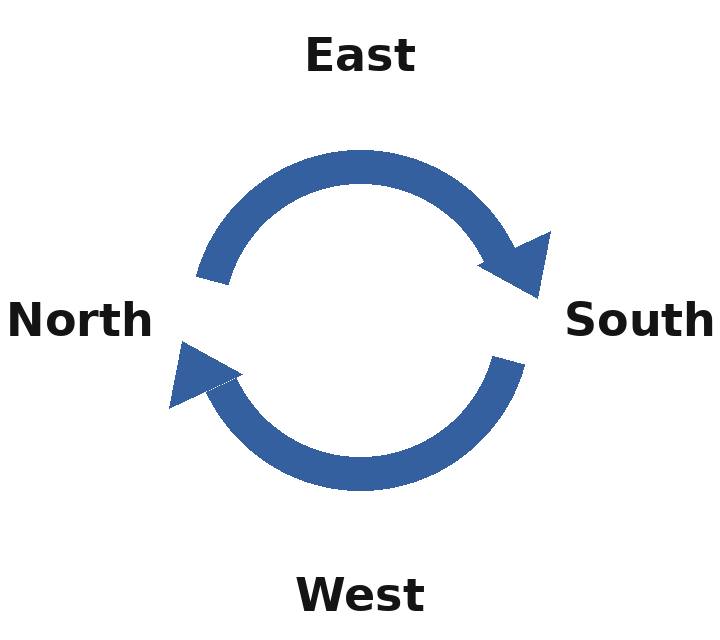
In the 16th century, the Rama of Fano, Rabbi Shmuel Algazi and Rabbi Yosef Samiga debated this. Rabbi Algazi understood from Rashi that the Kohen walks around like a crab, that is, sideways, always facing the altar, so that every turn is to the right. The Rama of Fano mocked this: “Then in the holy place the Kohanim would walk like the blind, groping along the wall.” In his view, “to the right” is the direction the palm of the right hand faces when you stretch it forward, that is… to the left.
The simple explanation, “right” as counterclockwise, seems to spare us all these forced explanations. And in the words of the Rama of Fano: “Every thoughtful person is free to decide between us.”
10